


My name is José María Toledo, recently baptised as Black Pope, although I look more like an albino Black popper with a sallow complexion.
But I am not here on account of my ecclesiastical titles. I am here because I reached the semi-finals of the Nationals with a rather unusual mono black deck: “Black Curitas”, as I and three other people like to call it — to everyone else it is a Zombies deck. I named it that because it is basically made up of clerics who look like they touch their own genitals rather more than the average priest is assumed to. Although, speaking as pope, I will say that nobody touches their genitals more than the average priest, and if these ones are black rather than white, it is because they prefer touching other people’s.
I should say that I am no Magic pro. In fact my career in this game, and especially in this format, is fairly short and relatively recent. So do not expect a deep analysis that sparks debate. What there is behind this result is a story that is, at the very least, peculiar.
I started playing Magic around the time Morningtide came out. Before that I had played at school like everybody else, breaking every rule in the game, and honestly I never had a pool (although little by little I developed an unhealthy addiction to acquiring cards that are only good as roach material). I got going at 26 years old, and only because I bumped into someone I knew from school — José Carlos Riego (a pro player on the Madrid scene, and a hedonist) — playing a tournament in a shop in central Madrid. I was surprised to see him there because back then I did not even know he was a geek. Afterwards we went to a friend’s house and I played against him; he was piloting an “Iggy Pop” with spectacular speed, using coloured gems to count the spells he had cast and the mana of each colour he had left to spend that turn, and I was thinking: can you really do all this in Magic? Wasn’t this about planting the biggest tree? He beat me on turn 3 or 4 without me having the faintest idea what he had done, and without me putting a single creature on the table. My friend was discouraged by it. In me it created a need.
But my career as a Legacy player, though intense, was not long. I played decks I liked, a fair distance from any archetype, and I picked up modest results in shop tournaments — until I fell out with the game. It was 2012 and back then I was playing a Stax-style deck with Elves that basically abused the elves’ ability to produce mana in order to lock the game up and kill in one go. It was a deck I had worked on and was proud of, but when people started beating me over and over with a single one-mana card (Delver of Secrets), I lost heart.
That, combined with the arrival of aberrations like Progenitus, Emrakul and the planeswalkers, turned the game into a vortex of superlatives that I no longer enjoyed. I quit, sold everything and forgot about it forever.
But “forever” ended one morning in December 2022, when I woke up with a brutal craving to play, despite not having spent a single thought on the little cards in the previous 10 years. There was no immediate trigger for an epiphany of that size, so I interpreted it as a message from above: “seeing as you have thrown your life away scratching your backside, get back to playing Magic, it’s dead cool, man.””
I looked in the shoebox and the only thing I had not sold was a deck of clerics that I had tried to play in a few tournaments back in my Legacy days, with very little success. Riego had already mentioned to me that there was a format called Premodern which had that flavour of the Magic I fell in love with, so I adapted the clerics to the format and told him to bring his decks. We tested a few pairings and, to our surprise, it was not bad at all. This version, which is the one I took to my first tournament in Valencia days later, looked like this:
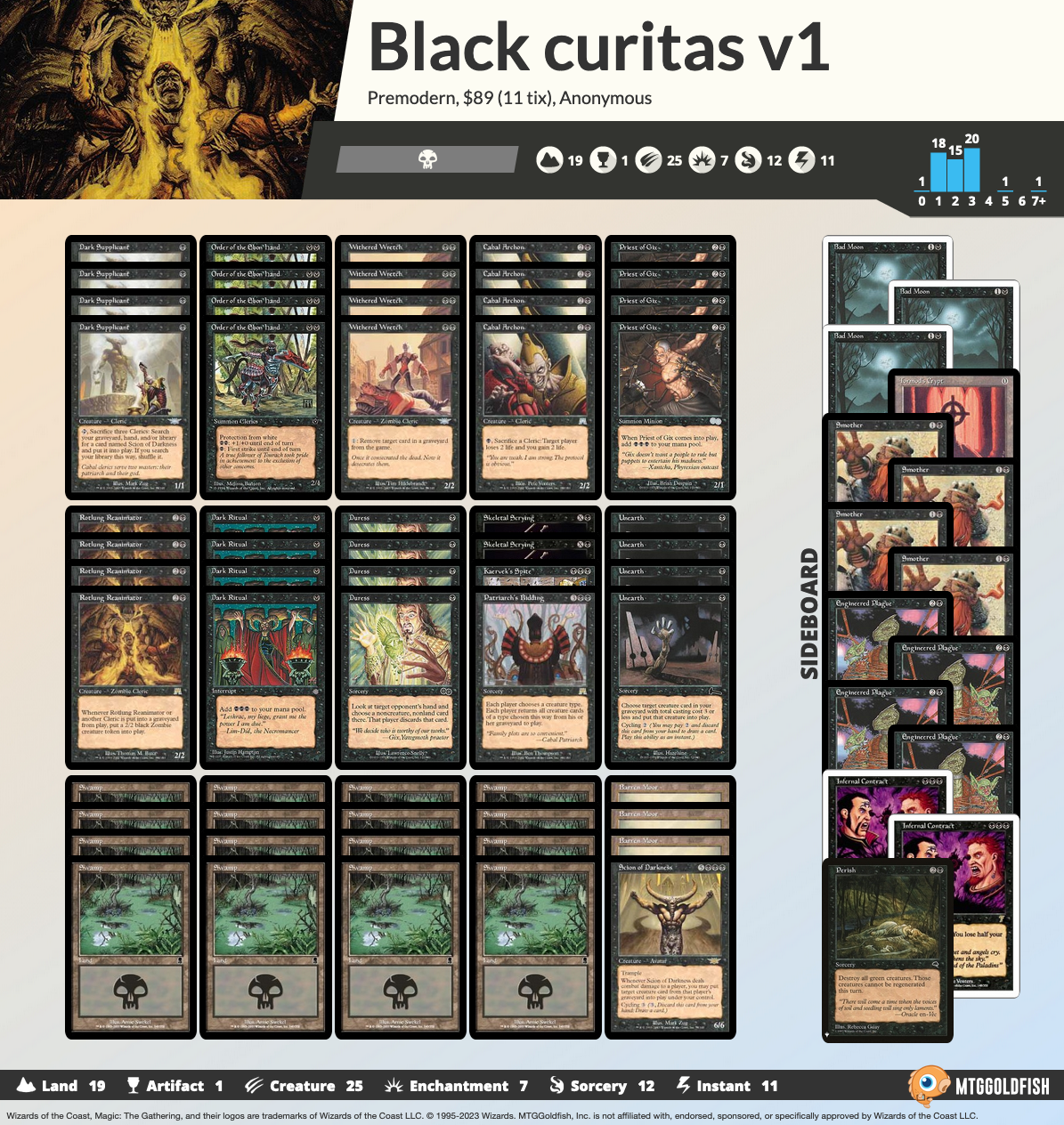
There are many cards I would not play today, but back then it was what I had.
After getting in touch with the organiser of the Valencia premodern league (Sete), and having him tell me that “asmorsar” — getting a proper breakfast in — was the only thing that mattered, I took my chances and went straight to my first premodern tournament, sense asmorsar, without breakfast. That was a little over 10 months ago. I think it was the sheer bewilderment of my opponents, or the heavy digestion of the sandwich they had just demolished, that let me steamroll everything until the last round, where I played against Pablo Suarez, better known as Pablo Llanowar for playing Mono Green Bears, you know how it is. I did not beat him because I thought it was a good idea to sideboard out the Scion of Darkness for game three. There was a moment where playing it at end of turn would have won me the game, but nobody knew it was not in the deck; they must have assumed I was an idiot for not realising I should cast it, when the truth is I was even more of an idiot than they could imagine. Pablo beat me 1-2 in the end and I finished second.
The sharper ones among you will have noticed that the deck is illegal. Back then I did not know that Fallen Empires fell outside the range of legal sets in Premodern, but the Technoliga lads turned a blind eye. Honestly, I came away with mixed feelings: on one hand I was surprised that this deck and I could put up a fight, and on the other it really hurt to have to replace the Order of the Ebon Hand, since they seem like the perfect fit and leave a hole at two mana that I still have not managed to fill. The current stand-in is Shepherd of Rot, the card I consider the worst in the deck in most pairings, and the only one that can save you in a few others.
Over the following months I kept playing it and making changes, I grew fond of them, I found out it was a more complex and recursive deck than it looked, I decided to call them “curitas” — little priests — and I went back to my old hobby of building bad decks with obscure cards, only to discover in the end that my little priests were not just the most fun but the best deck.
Here are examples of cards that came in and then left again before the Nationals (complete with the recommended number of copies as granted by the Concilio Cardinale di Bari):
Main
Patriarch’s Bidding (1x): In theory, once the game is somewhat advanced, this card is an autowin — even if your opponent casts it. Imagine you have a Gix and an Archon in the graveyard… checkmate, atheists! But for some reason, and with the sample I am working from today (some 30 tournaments), I almost never use it, and when I do it either gets countered or there is a Tormod’s in play. So, notwithstanding how good it looks in this deck, I ended up cutting it recently.
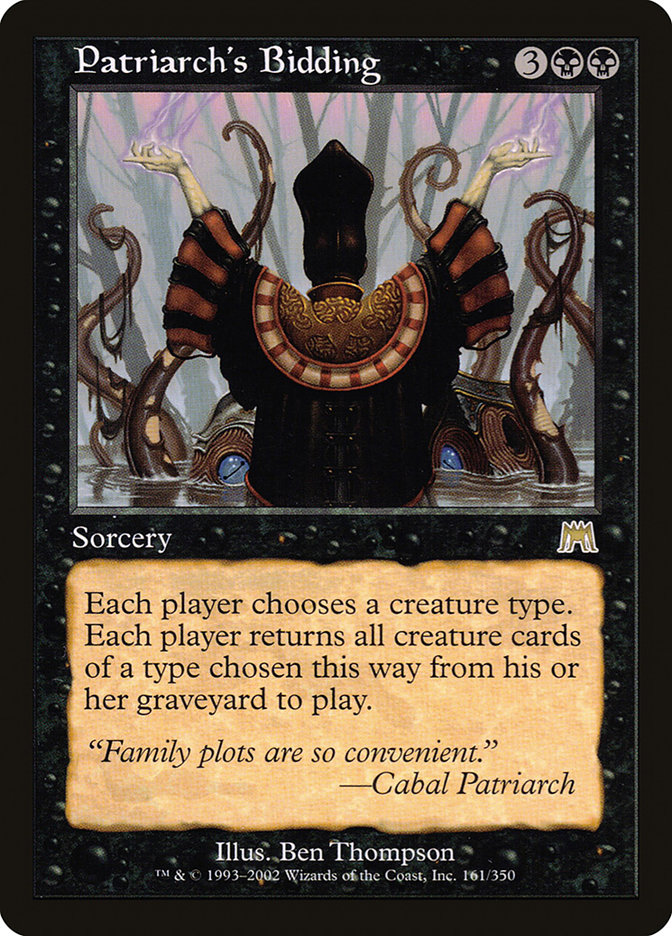
Living Death (1x): Since I have played the deck almost the whole time without creature removal, not even in the sideboard, this is a way of sweeping the table and putting the whole “club” down anyway. It is more efficient than the Orders if you have a way of sacrificing your creatures before casting it, and less efficient in plenty of other situations. On balance I think it is worse than the Orders.
- “Why no creature removal?”: In this deck, drawing removal means not drawing a little priest, and casting removal means delaying the twelve o’clock mass — a mass where the wafers fly thick and fast and which requires several officiants. In other words, you cannot ring the bells and walk in the procession at the same time. So the only removal I can see, and mostly out of the sideboard, is Snuff Out, for its flexibility and because you can cast it “for free”.
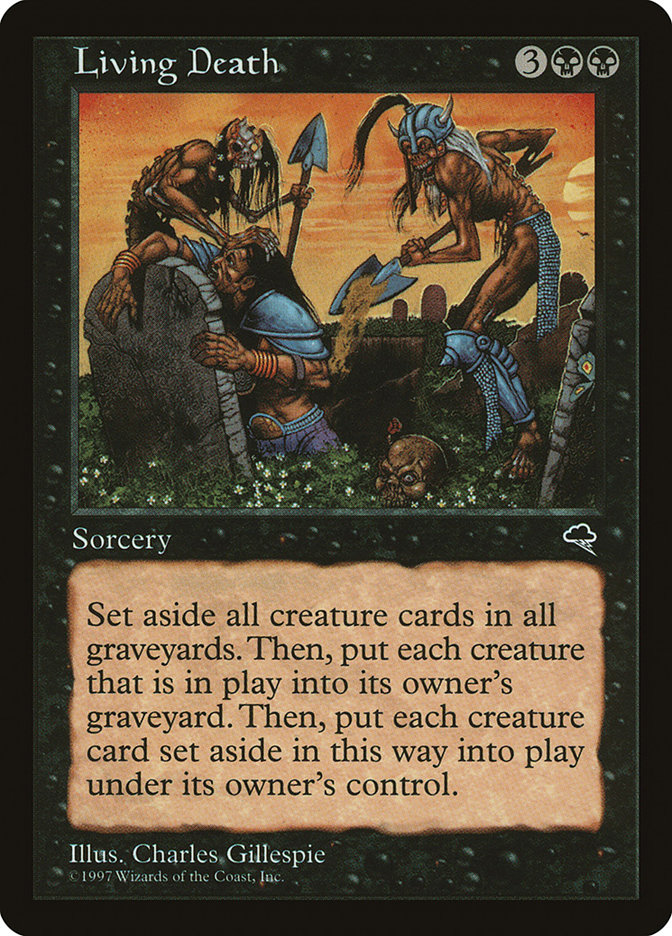
Cursed Scroll (1x or 2x): The most functional alternative to “draw cards” seems to me to be the Cursed Scroll. Firstly because this deck empties its hand almost immediately, and secondly because it has mana to spare in the later turns. The only reason I do not run it is that I do not play artifacts or enchantments in the main.
- “Why no artifacts and enchantments?”: This may sound childish, but another alternative to “drawing a card” in a format where drawing is so expensive, with a deck that runs out of cards straight away, is for the other player to be holding cards they cannot use.
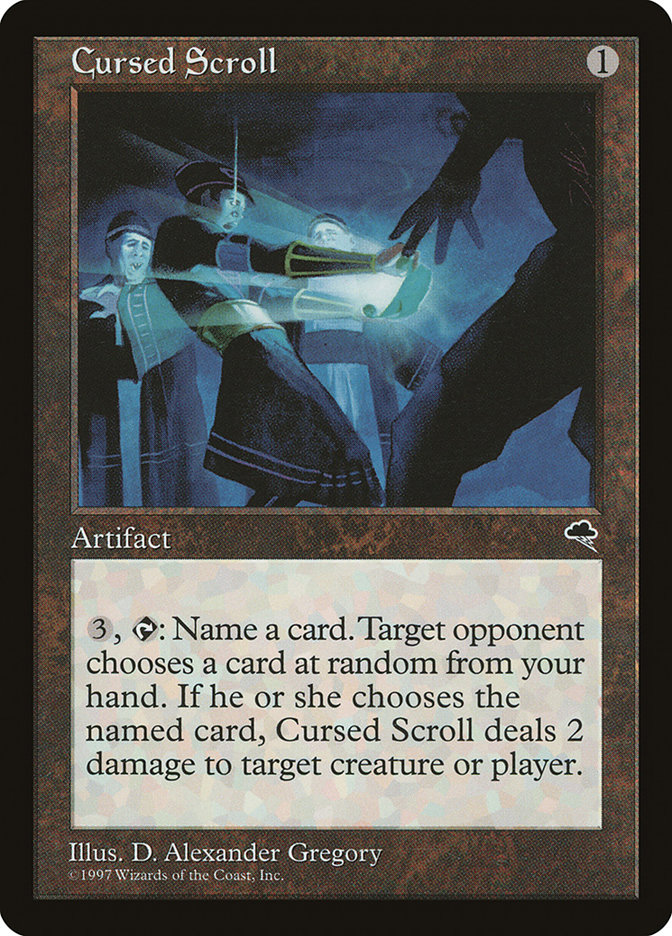
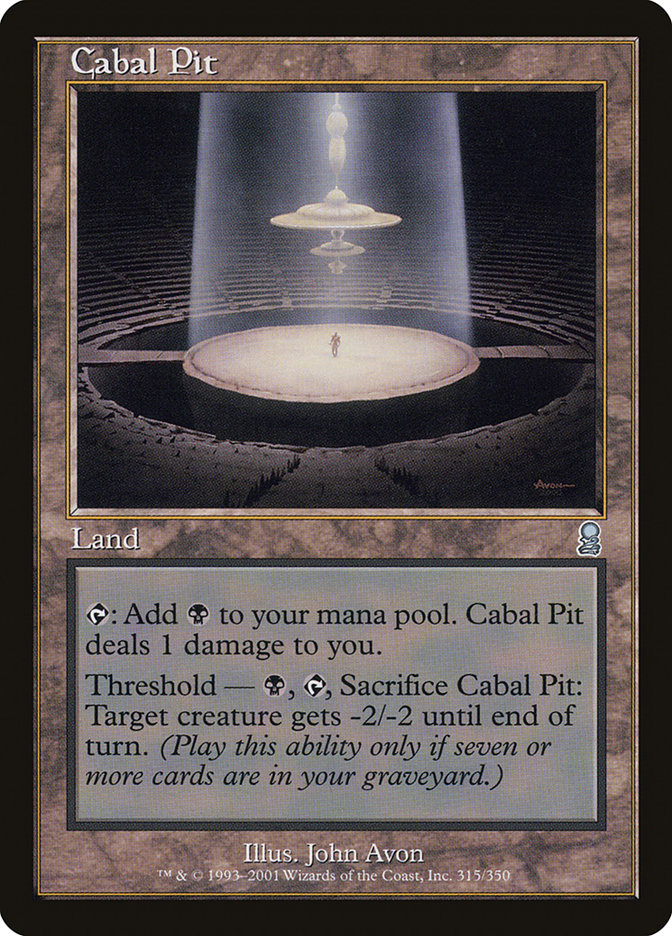
Cabal Pit (1x): A perfect fit. A few little priests in the graveyard, a couple of fetches, a couple of Duress and you can already use it. Even so I decided against it for the Nationals, because I am not keen on running non-basic lands and I do not think it is that powerful in this deck: Cabal Pit is primarily a defensive card, and we came here to evangelise by force.
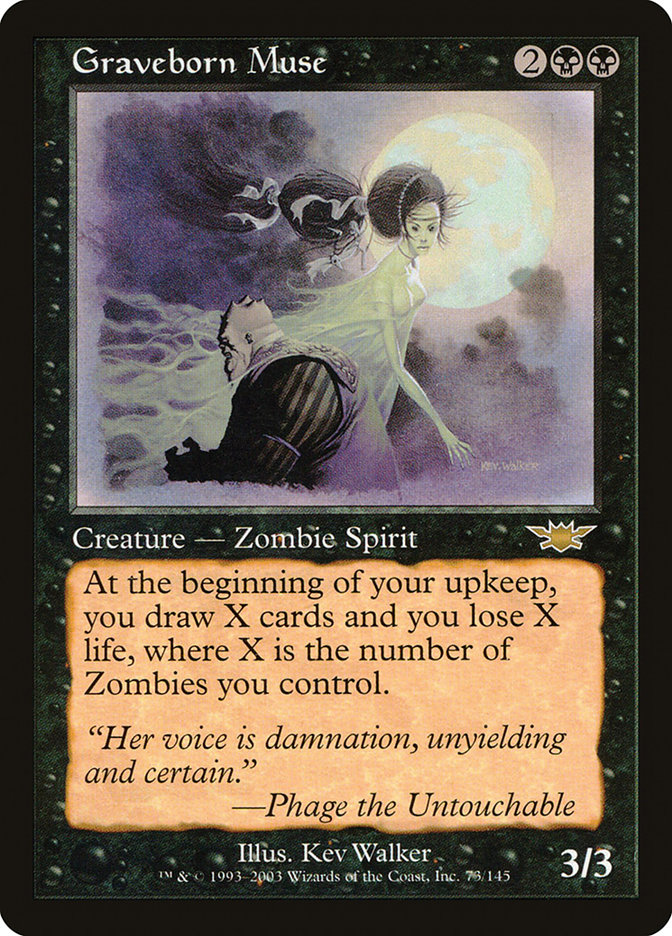
Graveborn Muse (2x): Another one of those cards that in theory ought to work, but which, in my small sample, has not given me much. It is true that it has certain advantages over a Phyrexian Arena (basically that it hits). But generally it is better to stick to your plan. A long game is winnable, but it is not what you want.
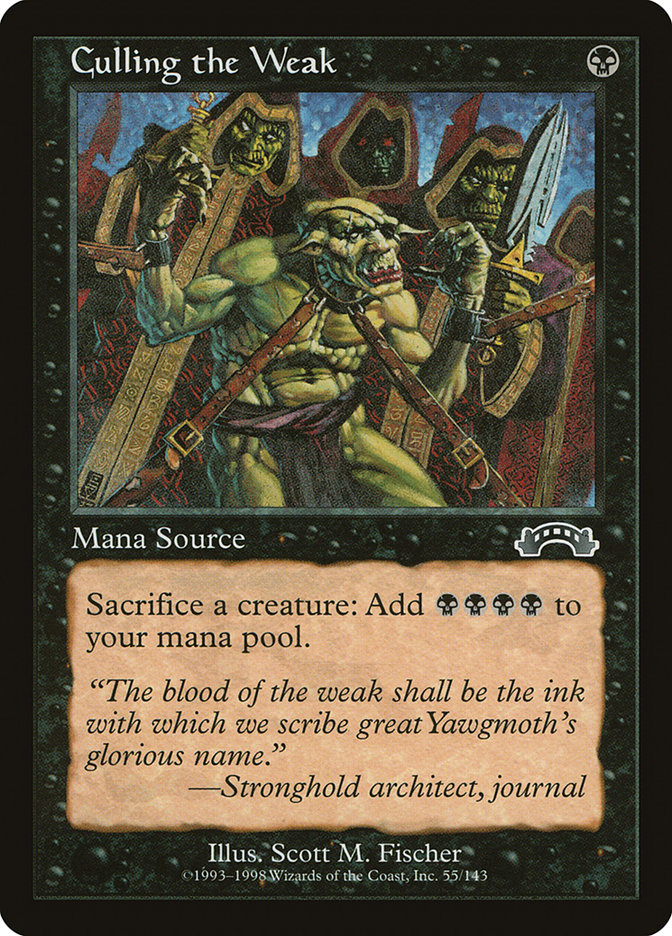
Culling the Weak (1 or 2x): I put it in to have more rituals and to combine with the Graveborn. But the perfect eclipse rarely turns up, and the likeliest outcome is that you sit there holding it with nothing good to combine it with.
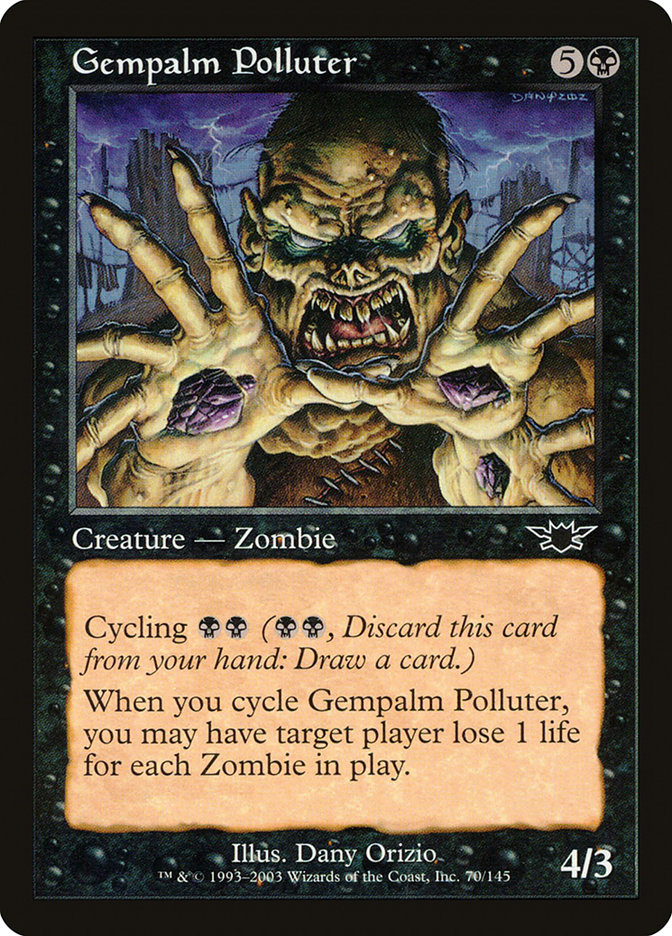
Gempalm Polluter (1x): The third leg of the zombie triad and the only card that lets you win in certain spots. Mind you, plenty of the time it will do 0 damage, because you cannot keep it in hand unless your opponent is on 1 life — you have to keep up the assault and cycle it, and in a deck that is tight on lands that can get annoying. The reason I did not take it to the Nationals is that it belongs to a different core, one where you also have to run Graveborn Muse and Diabolic Intent and end up turning the deck into something too recursive to be an aggro deck. I am not saying it is not a road worth taking, but there are other, equally passable roads.
- “What kind of deck is it?”: Depending on how you build it, it can be a very aggro deck or a midrange deck with several resources for delivering the killing blow. My build for the Nationals was somewhere in between. But a few months earlier I ran into the man who first proselytised at me in Madrid, Carlos Piélago. And he showed me his way of interpreting the word of the Lord:
 No me parece una mala construcción, lo único que le veo, es que el agujero en el coste 2, y la dependencia del coste 3, es todavía más marcada.
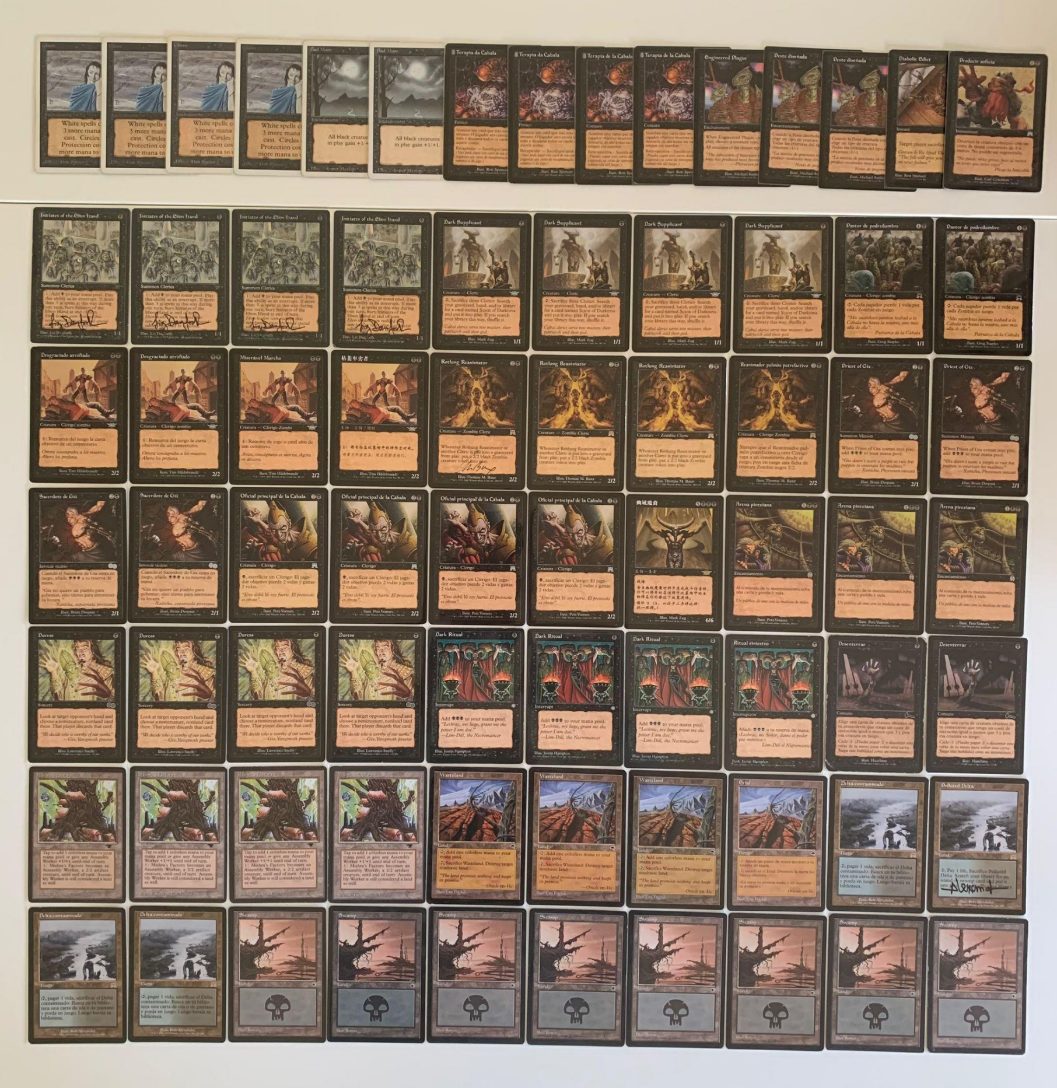
Initiates of the Ebon Hand (3x): A little priest for one mana, prays like the rest, and gets sacrificed for the greater good when necessary. So what if his little tail is smaller than the others’? Well, some altar boys like them that way…
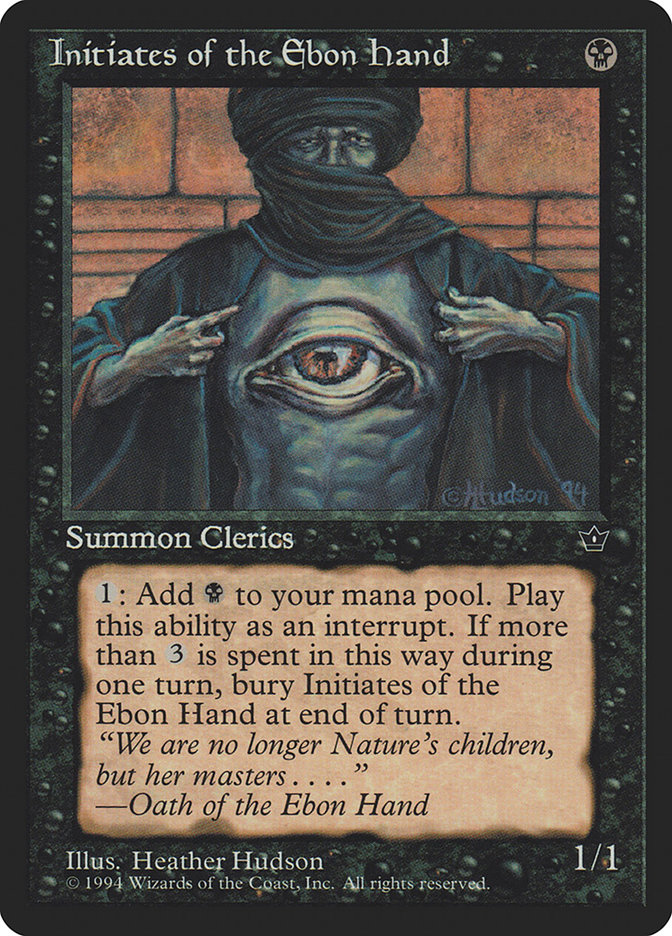
The problem is that it is the weakest of the little priests, and although it can partly solve the hole at two mana (1+1), doing so would mean cutting a copy of the priests of the supreme council: Rotlung, Gix and Archon. So I would only recommend it in versions where you want to run a lot of colourless lands, as in Carlos’s build.
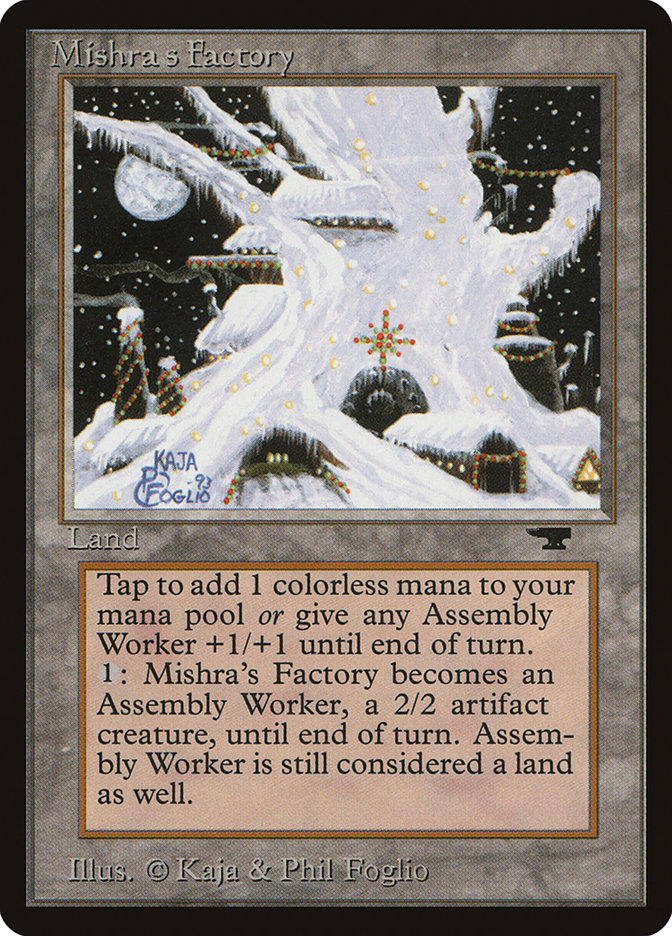
Mishra’s Factory (2 to 4x): This card is broken — bet you did not know that — but it is not going to fill your hole at two mana. You did not play it on turn 1, did you? And if you did, why did you keep that hand? You cannot pilot for toffee, man!
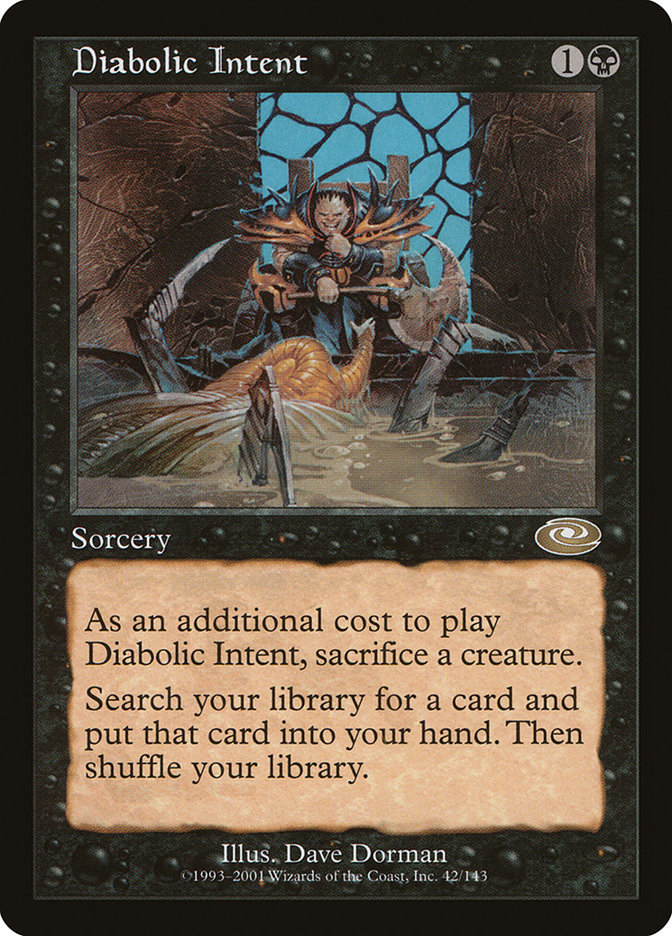
Diabolic Intent (1 or 1+1x): I would only recommend it in midrange versions with Kaervek’s Spite, Patriarch’s Bidding, Gempalm Polluter and the other one-ofs you might run in the sideboard. Sacrificing a creature is usually not as terrible as it sounds, except when you do not have one, but it is not free the way people sometimes think. A little priest is always a valuable resource, even when he is willing to sacrifice himself for the greater good. And not having to reveal the card makes your opponent pull a face, which is always a good look.
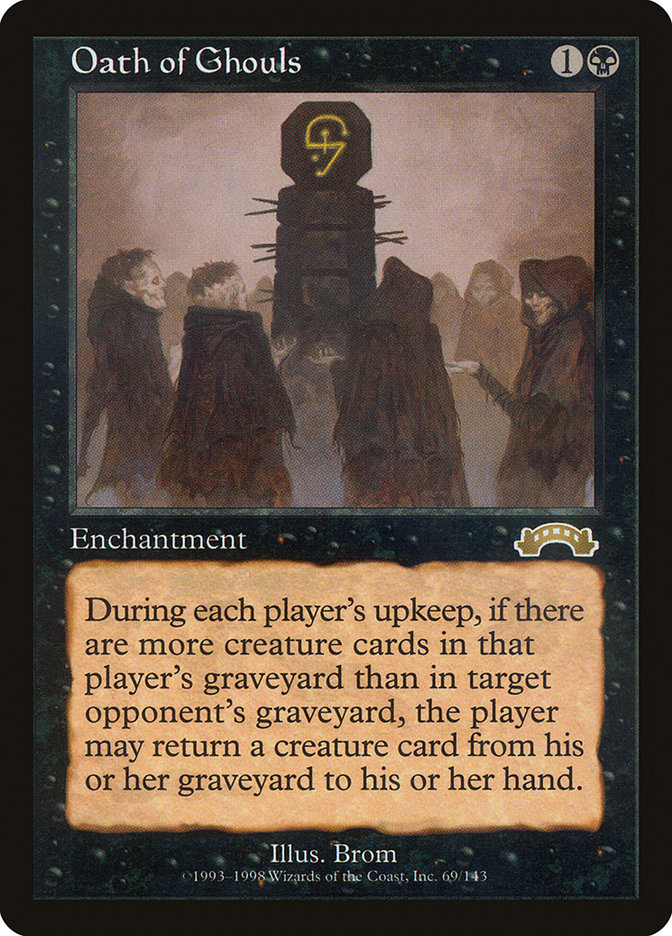
Oath of Ghouls (2 or 3x): Your opponent is rarely going to have more creatures in their graveyard than you have in yours. That is because this is a mono black deck with no creature removal and 4 Withered Wretch as standard. So it is an ideal card as an à la carte draw engine. But it is going to eat a Disenchant and you know it, and you will end up trading a card that could have been a little priest for some bloody Disenchant that the muppet across the table has been sitting on since turn 1. So I do not see it unless you are on a version with Cursed Scroll, Phyrexian Arena or other enchantments and artifacts. But in that case — can you fill the monastery well enough to carry out the ritual? Will you be able to head off a possible mutiny of the altar boys with so few old goats on the loose? That is for you to decide, but you look stretched to me, pal.
SIDE
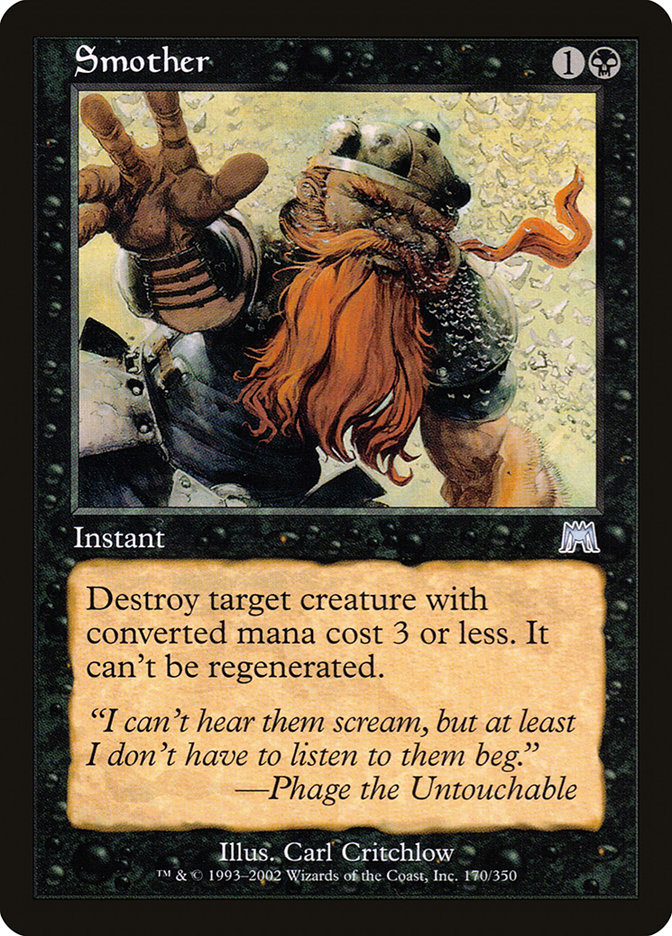
Smother: Do not do it. Back then I was short on pool; otherwise, why would I want a situational card that is going to slow down the perfect combination of little priests? If they put a shrimp down, let it through and try to beat them on the crack-back. In its favour I will say that at least it costs 2, and that if you run a lot of colourless land it can be mana you were not going to use that turn anyway.
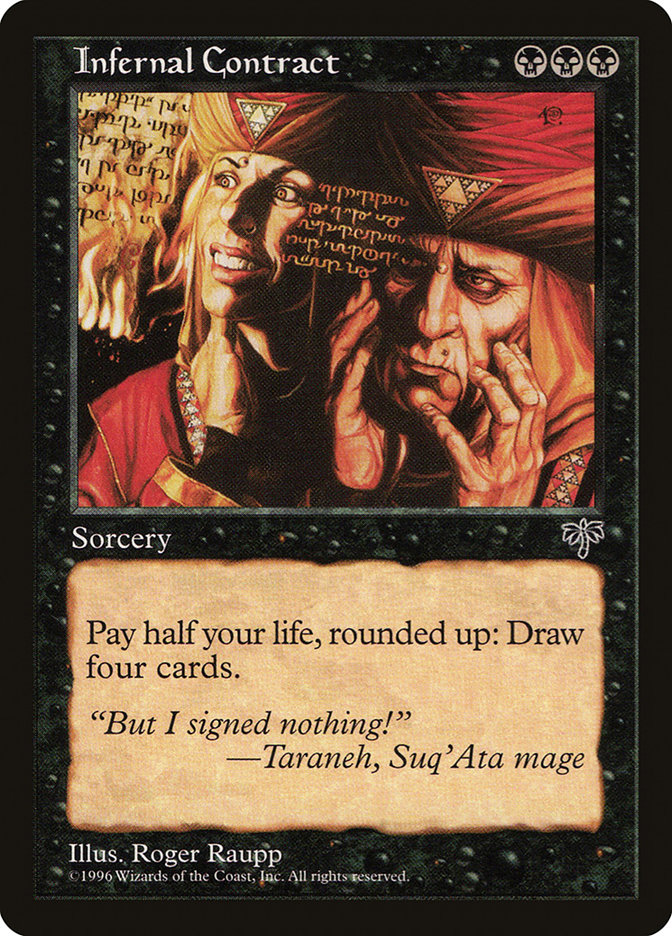
Infernal Contract: Despite the continued objections of my mentor Máximo Riego, I still think it is a good fit and possibly the best way for this deck to draw cards. I think it will be back.
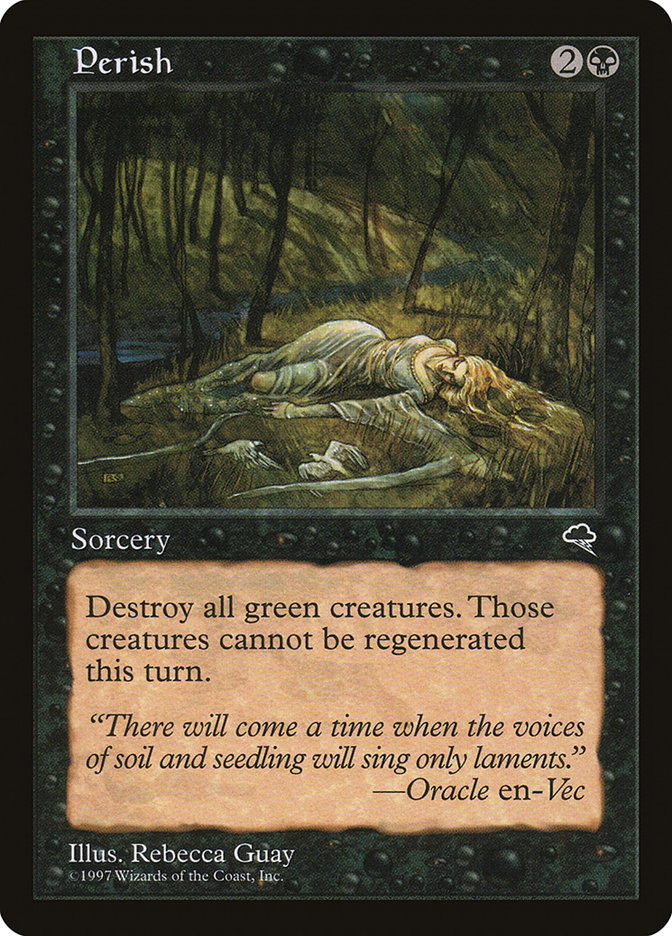
Perish: Green creature decks tend to hurt you a lot. So this is one piece of creature removal that I do think can be worth it, if your metagame plays a lot of green creatures.
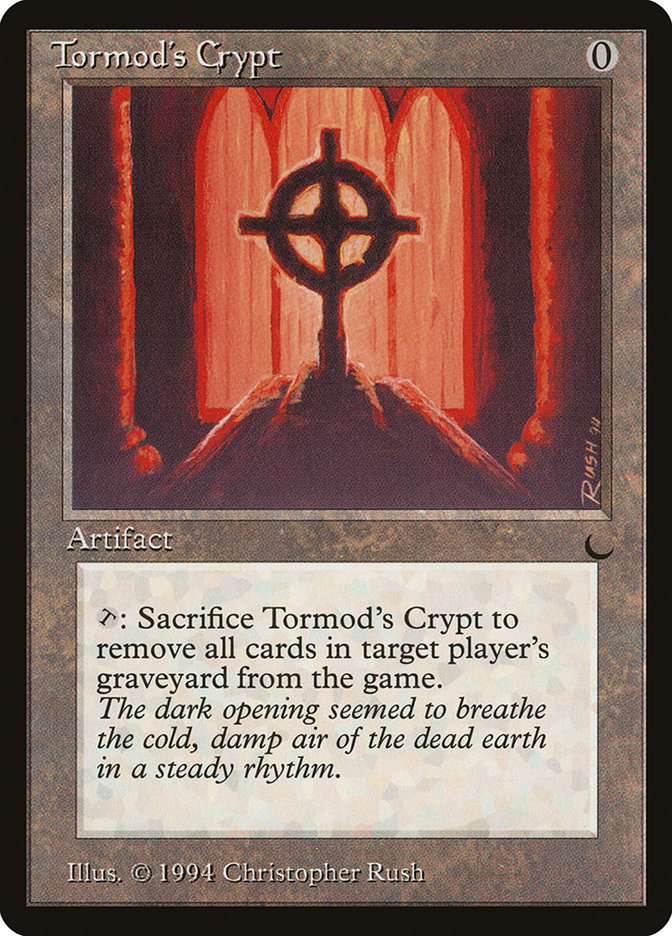
Tormod’s Crypt: You do not need it. You are already running the best creature in the format for that job in the main deck.
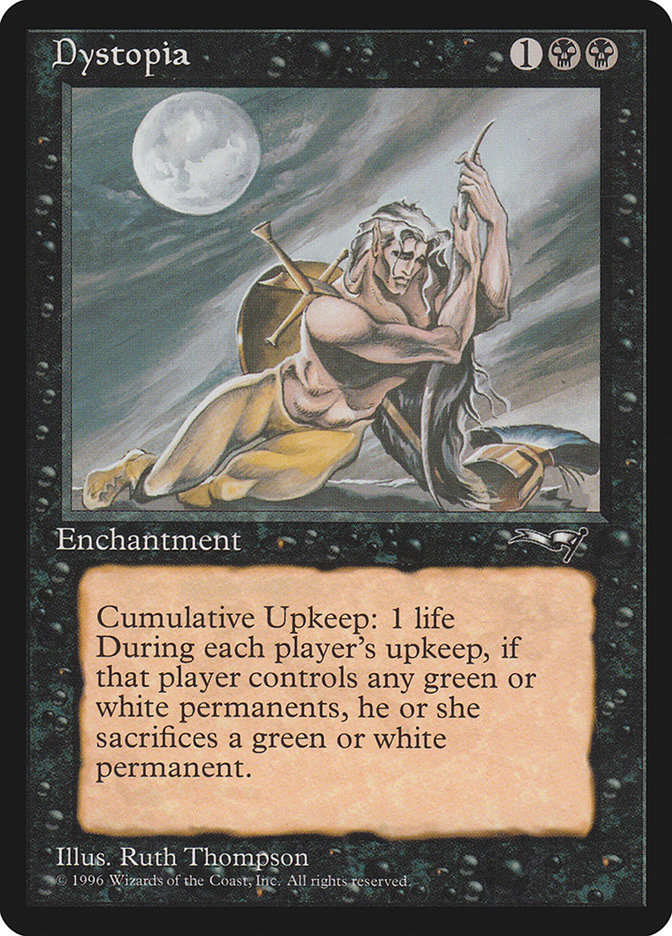
Dystopia: The only way to get rid of an Oath of Druids or a Survival, cards that beat you all on their own — but it is hard to manage and there is not room for everything.
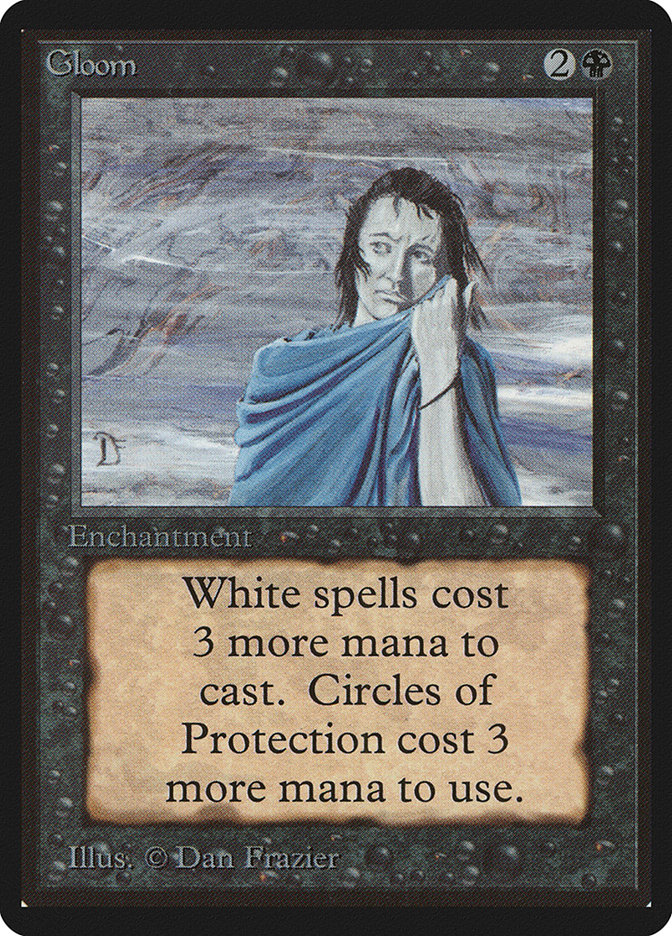
Gloom: Everything that hurts you most is white: Humility, Swords, Wrath, Parallax. If there is a lot of white in your metagame, do not think twice, pal.
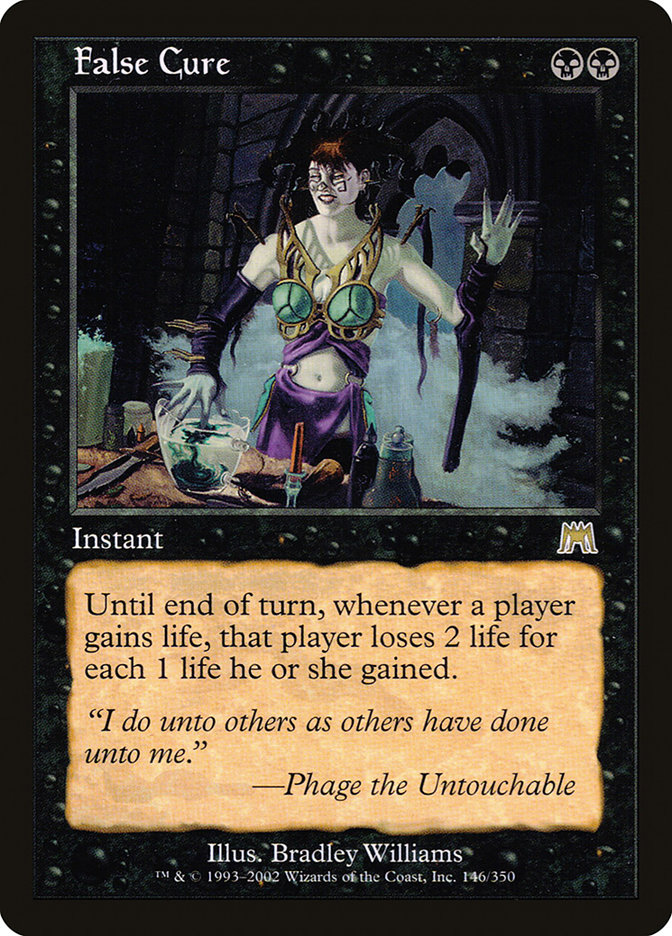
False Cure: I ran it for a while when Nishoba and Parfait were owning me and I was playing 2 Diabolic Intent (one main, one side). It is fun, but highly situational. If you like it spicy, put two spoonfuls in.
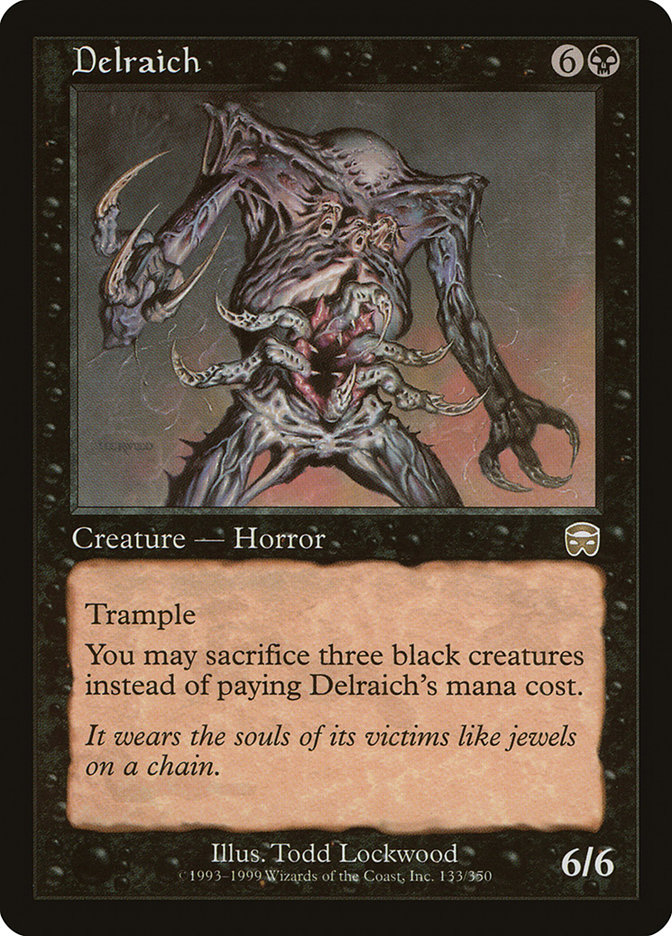
Delraich: The sod’s an absolute unit.
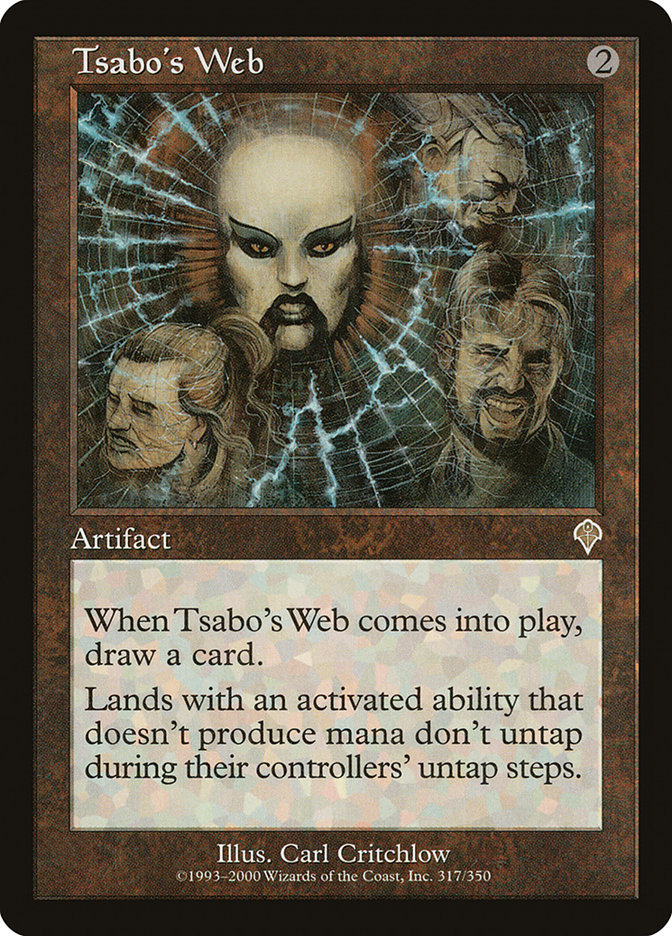
Tsabo’s Web: I think it is a great choice if you play a version without Mishra’s, Ports or Wastelands. I have lost games to manlands alone. That is how good this deck I am writing a whole bloody thesis about is, man.
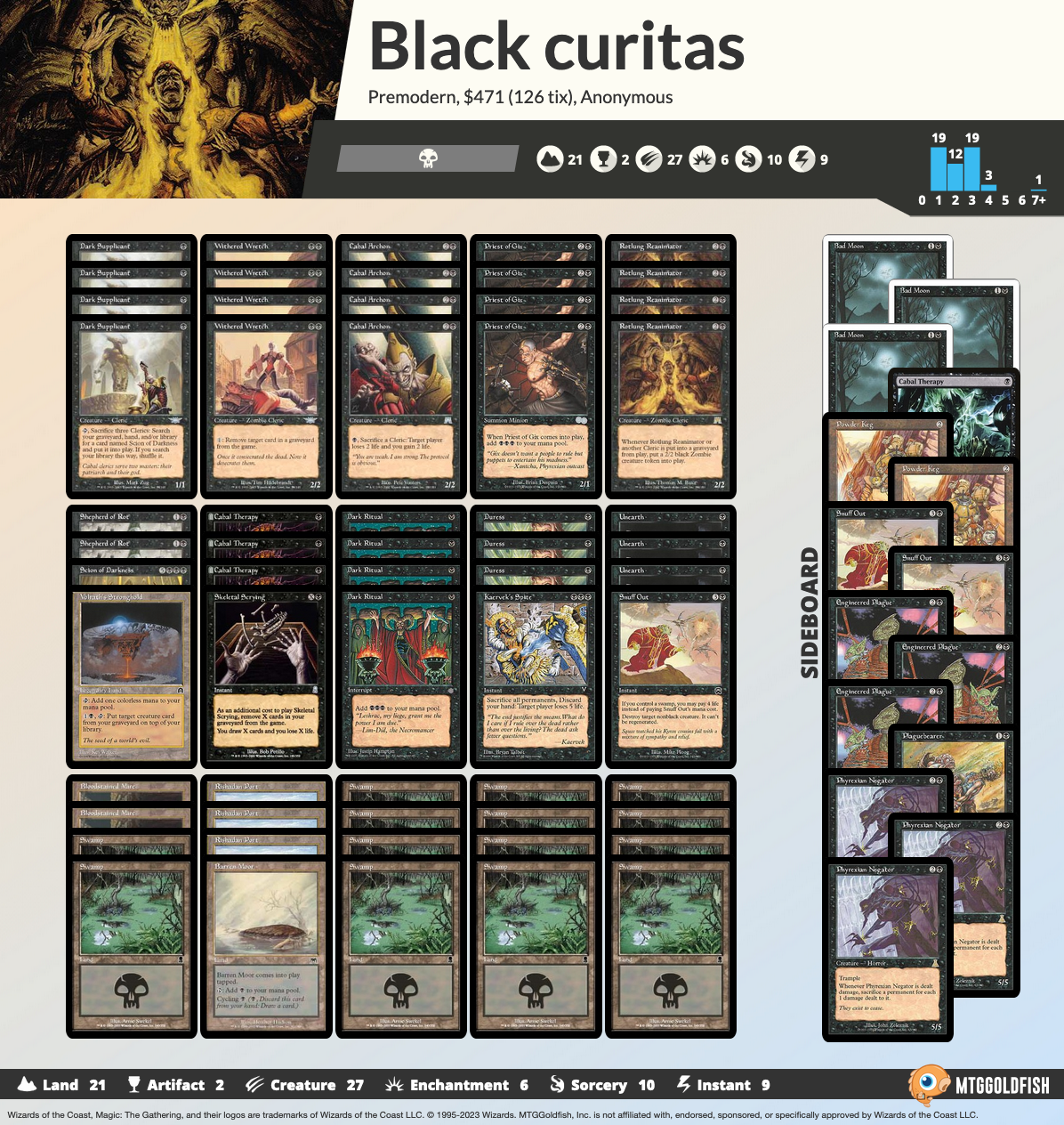
In any case, over the 9 months I spent piloting the deck there were no great revolutions. That changed at the Nationals, where the day before I had a revelation (that is, I panicked) and made quite a few changes. The final list looked like this:
 Todos los cambios los debatí con Máximo Riego que tuvo algunas ideas bastante interesantes.
Why these cards?
4x Dark Supplicant: Firstly because he is the most fanatical of the crew, secondly because the art is gorgeous, and thirdly because he is a one-mana little priest and the one condition sine qua non for completing the ritual. He rarely gets sideboarded out — only against pairings where having a creature on the table can hurt you and where the Scion, for all his muscles, is not big enough (e.g. vs Oath).
In any case, the option of pulling off a real heist is only possible with this creature down on turn 1 and a Rotlung the following turn with, say, a Gix alongside. And that happens more often than you would imagine. So for that small window of opportunity alone, he should be in there.
I do not recommend running any number other than 4, both because of the heist and because of the flexibility of being able to sacrifice all your creatures for some benefit when something is about to remove them from the game (e.g. Pernicious Deed). Against certain Rock builds he is the best creature in the deck alongside the Scion.
2x Shepherd of Rot: He is a priest, he is a zombie, and he lets you drain the opponent’s life without targeting them. On top of that, if you play a lot of colourless mana (Mishra’s, Rishadan and so on), he means you do not waste turn 2. On the other hand he is weak and expensive, and possibly even counterproductive in some pairings. That is why he is the card I sideboard out most. But bear in mind he is also a card that makes it possible to draw very unfavourable matchups. You could run more than 2, but not fewer. That is: the options are 2, 3, 4 (if you are truly unhinged) or 0.
- Life loss instead of damage: Several effects in the deck make the opponent lose life, and that can matter in a number of pairings. It gives the deck an edge over other aggro decks that may be faster.
4x Withered Wretch: This little creature, in this deck, is the best creature in the format. He is a little priest, he is a zombie, he has the best cost-to-power ratio in the deck, you generally do not care that he costs two black, he is the best card in the format against graveyards, and he has the mana cost the deck most wants. So you will rarely sideboard him out, because he shows up in every scenario. I cannot see a build of this deck without 4 copies; you could debate 3+1, in the same way you can debate any old nonsense, but you would have to make a great many changes before it stopped telling you that you are a chump.
4x Priest of Gix: This is the deck’s most playful and fetishistic little priest. Explosive starts with him feel lovely, even though they are in fact less explosive than your opponent pretends they are — because putting down three clueless one-power little priests while spending 5 cards is the fastest way to make a fool of yourself. Even so, he is the little priest who enables every heist this deck is capable of. But take it from me: if the Rotlung has not come down after the Gix, do not get excited, pal — that play can hurt you more than it hurts your opponent.
Another plus is that he is the most willing of them all when it comes to attacking or blocking, and he dumps the problem on your opponent of working out whether it is worth blocking him or letting him through. If they block him, he can be a decent home-made ritual in combination with an Unearth, and if they do not, this waste of space nobody would have given tuppence for has just got two damage in. I never thought he would go so far, brother.
There is only one number of copies you can run — four — to maximise the chance of him coming down with a ritual on turn 1.
4x Rotlung Reanimator: This little priest has never been as effective as he is in this deck. Whereas in zombie builds he is simply a creature that leaves a zombie behind when it dies, in this deck he is a zombie spammer that has resulted in me having more zombies than my opponent in games against zombie decks. Another side effect is that opponents often do not know what to name with the plague, which gives them the chance to get it wrong.
He is a card you always want to see, because he brings reassurance and is a condition sine qua non for the heist in combination with the Dark Supplicant and one other little priest. He also makes Kaervek’s Spite a less risky play, and enables certain residual lines where it is even worth casting him although your opponent is not going to die as a result. You have to run 4, because he always brings something, although he can be sideboarded out against pairings that are never going to touch your creatures (e.g. vs Stasis). As with Dark Supplicant, he will always be part of the deck’s most aggressive plan (Gix, Rotlung and Supplicant on turn 2), so if you do not want to lose that option, leave him alone. He is sticky, too.
4x Cabal Archon: This is the deck’s Michael Jordan — Mohammed “square bollocks” Bruce Lee, before he converted to Dark Catholicism. He is the difference-maker, and the one who wins 40% of the games thanks to his activated ability. But of the holy trinity clogging up the three-mana slot, he is the only one you can consider cutting a copy of.
And why, if he is so good? Firstly, you should only do it if you know how to look after him properly, if you understand that he is really a four-drop (since you cannot cast him without leaving mana open, in case he eats a Swords) and that the Unearths work for him. Secondly, he is a creature you do not actually want to see early: he is the worst companion for the Gix or the turn-1 ritual, and you had better not waste him. So, for a brief stretch of the game, he is an almost dead card, a plain 2/2 for three mana.
If you do go down to 3 in the main, I recommend keeping the 4th in the sideboard, because he is the difference-maker against pairings like Sligh, Goblins or mono black aggro.
-
What is this about the three-mana pile-up?: One of this deck’s biggest weaknesses is that the entire engine costs the same: 3 (Rotlung, Gix, Archon). Add to that a deck that does not draw cards and is short on lands, and sometimes it simply never gets going.
-
“Why not run more lands, man?”: The number of lands I have run has ranged from 19 to the 21 I took to the Nationals. Any more is madness, because you lose all evangelising power if you draw too many. You can add fetches, Barren Moor, Volrath’s, Unholy Grotto, Starlit Sanctum or coke; but it is still going to be a bloody land when what you wanted to see was a little priest in all his sex appeal. The little priests are addictive, and there are already several companies making a fortune out of inflatable priests for insatiable children.
1x Scion of Darkness: This creature has an additional cost: when he hits the table you have to raise your hands to the heavens and sing “Sciooon of daaaaAaaarkneeeeess!”*. Otherwise the rest of the acolytes might suspect you are not fully committed to the business of summoning a demon pumped full of steroids. If you pull that stunt, the most likely outcome is that you immediately eat a Swords and receive an enriching lesson in humility.
The only number I recommend is 1, because “the chosen one” is one, and that is that. Besides, in a family cult like this one, having several of them would strip a great deal of mysticism from the whole affair, quite apart from creating schisms — Scions — and parallel rituals. As for sideboarding him out, I only see it in marginal situations, since summoning him, whatever the Dark Supplicant may tell you, is not the ultimate goal but merely a situational resource, a utilitarian alternative. If you do decide to board him out, you should take the Dark Supplicants with him in nearly every situation.
*The capital “A” denotes a falsetto.
3x Duress: The only reason to play black is the Duresses; the question is not “Why Duress?” but “Why not more?”. In this case it is because the number of little priests would come down towards the critical figure of 20, which would mean that in most situations they would have to masturbate on their own. And also because sometimes it whiffs, and in a deck with so little fuel that hurts.
- Why at least 20 little priests?: The little priests are gregarious, carnivorous beings who constantly need company for their hobbies and rituals. With fewer than 20 it is hard for more than 2 of them to meet in a cloister of the monastery for their rituals and sacrifices.
3x Cabal Therapy: Are you a Duress person or a Cabal person? Honestly I could not care less, but depending on your answer the decision can swing across the whole range of permutations adding up to 6. If you play the
muse or have draw engines, maybe you should lean towards 4 Cabals, and if you do not know the metagame well, go for the Duresses. Since I am guilty of both, I run 3 and 3. But if you can find the room, you can play all 8 and go round telling people about it without anyone having asked.
3x Unearth: I should say that the Nationals was the first time I ran only 3 Unearth, and given the results I am not going to criticise that decision. But Unearth is a tremendous card in this deck, with the sole drawback that you can have 2 in hand and nobody to dig up. If you are the sort who enjoys going to cemeteries to dig up teenagers, you can run 4 and relive the good times, but I think the sensible number is 3, much to my regret.
4x Dark Ritual: Because the little priests have unlimited access to virginal souls.
1x Skeletal Scrying: Divination is a good card for refilling your hand in this deck, above all for the flexibility of casting it at end of turn on the turn you left mana open for the Withered or the Archon. So you could say that, with patience, it is free — although only at a stage of the game you do not want to reach.
I do not see running more than 1, because there are not that many cards to eat (it is not right to cannibalise your brothers) and because it is very likely your opponent will bring in graveyard hate for games 2 and 3. That is why the Infernal Contract alternative, if what you want is to draw without depending on the graveyard, is riskier, but seems acceptable to me too.
- Which is the best card for drawing?: Possibly none of them. I chose to take a single Skeletal Scrying to the Nationals, but if you do not mind running artifacts or enchantments in the main, Cursed Scroll or the Arena are acceptable options. Infernal Contract out of the sideboard against control decks can be quite interesting, because the life loss is not a cost but an effect.
1x Snuff Out: I threw it in on a whim. That morning I got stuck in a loop between the 4th Duress, the 4th Therapy and the 4th Unearth, and in the end this seemed the least bad option. I put it in intending to hoard it like a very valuable wildcard, only for extreme situations, and I ended up using it at the slightest excuse. I do not think it is an optimal main-deck card, but I wanted at least 3 between main and side and the sideboard was tighter than a monkey fight. A bodged solution that worked.
1x Kaervek’s Spite: It is not once or ten times that someone has picked up the Kaervek to read it and looked at me as if to say “you are out of your mind”, but I have to say this card is much better than it looks. In fact it is the single card that wins me the most games, and in a deck that scratches away at life totals, it is something you almost always want to see. You should not be so afraid of counterspells; just play it with a bit of thought and set the situation up beforehand, and that is enough. The fact that it is an instant gives it enormous flexibility in that respect, and you do not always have to play it “for the finish”.
1x Barren Moor: This deck has a toxic relationship with lands: you desperately need them until turn 3 and after that you want them to vanish from the deck. I have run as many as 3 Barren Moor, but I think 2 is the maximum. Riego was sceptical and told me that if I never cycled it, it was a bad decision. But I did cycle it successfully several times and it never got in the way. It is a little kid’s solution, but this is a little kid’s deck — what do you want?
1x Volrath’s Stronghold: In the frenzy of finishing the deck I threw this one in too. I had never played it and I think it is a mistake. Climbing onto the thing is enormously expensive, and it is not worth the risk of it slowing you down by not producing black mana in the early turns. Besides, I do not think there is any priest so indispensable (maybe the Cabal Archon) as to justify paying the cost when you might simply draw him again, or draw an Unearth. I used it once, and more to set a trap than to gain anything. I would not run it, because I think there are better and cheaper alternatives like Starlit Sanctum or a swamp.
2x Polluted Delta: The theory of thinning lands out of the deck with fetches is debatable. The marginal effect of removing one land from the deck for your next draws is comfortably matched by the chance that the life point matters, that you eat a Stifle, or that you are thinning out lands when in fact the fetch is the only land in your hand. So I ran 2, more to feed the Skeletal Scrying than anything else.
3x Rishadan Port: In the end I settled on Rishadan Port as the colourless utility land to run, to alleviate the flood problem and to cover, in a way, the deck’s hole at two mana (Wasteland does not do it and neither does Mishra’s). I went to the shop and bought 3, because 4 ways of drawing a colourless land on turn 1 seemed like too many. But now that the money is spent I have changed my mind, and I think a couple of Ancient Tombs solve the problem better and fit better with the Tsabo’s Web, although I have not been able to test that yet. I have opened a Kickstarter for the experiment; put 10 quid towards the cause and I will post you a clerical collar to wear at the base of your tail.
Even so, the Rishadan works very well. It can control the opponent and tap down those manlands that hurt so much, and it does all that without missing a land drop, which is something this deck cannot afford in the early turns.
14x Swamp: Mind how you go around these parts, traveller.
SIDE
3x Phyrexian Negator: I had never run it in this deck before and it was another of those last-minute additions, mostly to fight Landstill, a pairing this deck finds harder than traditional Chinese. I think it is a good decision (imagine Gix plus Negator on turn 1) but I never saw them when I needed them. They are also good against the classic game-2 Cursed Totem.
3x Bad Moon: Bad Moon is compulsory in the sideboard, and not only to hit harder or win the fights against other creature decks, but because it is the only way you have of protecting yourself from the plagues, which beat you. Three may not be enough, which is why you have to back it up with discard. If you go for the more aggressive version, you can even run them in the main.
2x Snuff Out: I gave in to several friends insisting I had to run creature removal, and in the end I picked the one that would not interrupt the flow of evangelisation. It feels superb; in this deck it is light years ahead of a Smother or a Diabolic Edict. I have not tried Vendetta.
3x Engineered Plague: Nobody is going to argue about how good this card is, but given how tight the sideboard is, maybe running 3 is not so necessary.
2x Powder Keg: Manland decks and Cursed Totem beat me, so I went for the kegs as a way of answering them. I never got to use them against manlands — either they did not show up or they did not survive long enough to break the Totem. I am not sure I would run them again.
1x Plaguebearer: Option B against Manlands and shrimps. Maybe I should run more of these and fewer kegs.
1x Cabal Therapy: For the pairings where you absolutely have to take a card. I think the other Duress should be in the sideboard for the same reason. In the end they are cards that are collaterally useful in almost every case.
As a corollary to this card-by-card analysis, I should say that if you do not want to spend much money, I think it is a perfectly functional deck once you replace all its expensive cards:
-
3 Rishadan for 2 swamps and a Barren Moor.
-
1 Volrath for a Starlit Sanctum or a swamp.
-
2 Polluted for 1 swamp (leaving you on 20 lands).
Powder Keg, Negator and Snuff Out for more Bad Moon, plagues, Funeral Charm, Perish, Plaguebearer and so on.
THE NATIONALS
My memory is poor, and if you add to that the fact that I slept badly on the Saturday because some schemers from Madrid led us astray, the result is that I am not going to remember specific plays — but I do remember the pairings and the general feel of them.
Swiss round 1 vs “Stasis”
In the first round I was drawn against a fellow Technoliga member and one of the finalists in the “best person ever” tournament: Andres Torres. That does not stop him being competitive and a great player, so when I sat down opposite him I mentally wrote the round off, since I had never beaten him before.
He won the first game by locking me out with Stasis, Forsaken and Root Maze fairly early. I refused to concede and we sat staring at each other draw after draw for a while; when I worked out that I would deck myself first, I conceded.
In the second game I cast a Duress and, between a Root Maze and a tutor, I took the tutor. He confessed afterwards that if I had taken the Root Maze he would have beaten me, because the sly devil had stashed another Root Maze on top with a Portent.
In the third, mass discard won it again: I disarmed him and then mugged him, like a small-time crook in his prime.
It was a pleasure as always, and he was the first to congratulate me on my run at the end of that first day.
Swiss round 2 vs “Astral WR”
Honestly I do not remember much about this round, because it was over in a flash. Victor, another Technoliga member, and I were drawn on table 2. If it had been televised, the word of the Lord would have spread as far as Yemen, because I remember winning both games very fast, one of them on a near-perfect hand.
Swiss round 3 vs “Goblins”
My first encounter with Carlos Orellana at the same tournament. Goblins is a deck I have tested a lot against my friend Fernando Ros, and although he says he is not a good player, he has beaten me a considerable number of times — whereas at the Nationals I did not lose a single goblin pairing.
I do not remember the match well, but it was relatively tight. You can tell Orellana is a good player and he applied plenty of pressure. It finished 2-0: I came out reasonably well in the first and won the race, and in the second I waited to drop the plague at the moment he had 3 Lackeys and he could not recover.
Swiss round 4 vs “Landstill”
Against Landstill I find it harder than traditional Chinese; this pairing shows you how ridiculous your deck is when you watch a bloody land drop of theirs kill any of your creatures. The only option is to mug them, and to do it brutally. My opponent was Cumplido, a well-known player on the Madrid scene. I had played against him before, but not against Landstill.
Beyond having the matchup in his favour, he played well: he won the first, I won the second, and in the third he pulled a plot twist that snatched away my chance of going 4-0 — he cast an Exalted Angel. I had taken out all my creature removal and the Angel connected. The gap it opened every turn was simply too large: game over.
Swiss round 5 vs “The Rock”
The Rock is a pairing that, even though it has a card that disintegrates me like Pernicious Deed, is usually good for me. But this version was far more competitive against my deck: no Vendettas, and with removal that actually kills my creatures, plus it was piloted by a player (Orco Fury Negro or something like that) who played rather well.
He won the first and it was the hardest blow of the tournament. I did not think a Rock deck was going to end my chances. I focused, fought out the next two games, and with the clock in its death throes I got the 2-1. I dodged a bullet, but it would not be the last of the tournament.
Swiss round 6 vs “Gro-A-Tog”
Dominique is a lad from Madrid I barely know but like a great deal. We played a very entertaining pairing, tense but friendly. I think I won 2-1 with plenty of suffering. He played well, at one point he had a 1000/1000 dryad on the table and I had to solve a sudoku of Meddling Mage removal in order to play at all, but in the end I held on. The most notable thing about the pairing is that at one point he named Gix with the Meddling, but if he had named Rotlung I would have been in Timbuktu. He confessed afterwards that he had been on the verge of naming it. That is Magic: a tiny detail tips the scales, and that day I had God on my side.
Swiss round 7 vs “Goblins”
Despite it being a favourable pairing I ended up agreeing to a draw, partly because Riego was waiting for me outside — he had already drawn against his friend Poza — and partly because otherwise everyone would have had to play and there was more appetite for going for a beer. If I find myself in the same position in future, and I am fresher, I think I will play it out.
Riego, Fernando and I called it a night after a beer, with the idea of maybe heading to Tadeos later. In the end we had dinner in a craft beer place, chatted for a while and tiredness got the better of us. It was finally time to sleep the number of hours the WHO recommends.
DAY 2
Round of 16: Black Curitas a.k.a Black Pope vs Carlos Orellana
I arrived quite nervous. Everyone was amazed that a deck like mine had made it this far and the displays of love and support were getting a bit much for me. Carlos was on the play and we had a lovely first game. He was calling the tune and it looked like he was going to win, but then, with him on 11 life and me half dead and beaten, I drew the winning combination. I had an Archon on the table and three mana, and in hand a Gix, an Unearth, a ritual and a Kaervek: it was done if I attacked with the Archon and it connected. I attacked and he did not sacrifice any of his creatures to block, so it was there for the taking… but I made a mistake that Orellana punished very well. The plan was to make 3 mana, cast the Gix and, with the three it gives you, eat the Gix and the Archon, cast the Unearth on the Gix, make 3 mana and throw the Kaervek at him: exactly 11 damage, the evangelisation of my dreams. But instead of playing the ritual first and then the Gix, I played the Gix first with my three mana so as not to reveal my ritual, and in response to the Gix’s mana ability going on the stack, Orellana killed the Gix. I lost the chance to eat him and could only deal 9 damage. I had lost to a fairly childish mistake.
I won the second game sweating, but comfortably enough. I do not remember much, but I do remember a Scion of Darkness evangelising a goblin the hard way. That goblin has since erected a chapel in Girona and his parishioners say he is always willing to help his neighbour. Unfortunately he ran over a minor and is now awaiting trial.
I began the third with a mistake too. He plays a Lackey, I put down a Supplicant, and he casts a Gempalm to get the Lackey through; I had a Snuff Out and instead of casting it so that the Gempalm would not kill the Supplicant, I cast it afterwards. I do not know why — I thought the Gempalm was going to kill me anyway. Even so, fighting again, I won it. Another bullet dodged. My guardian angel told me he was worn out and that I could put a bit of effort in myself, mate.
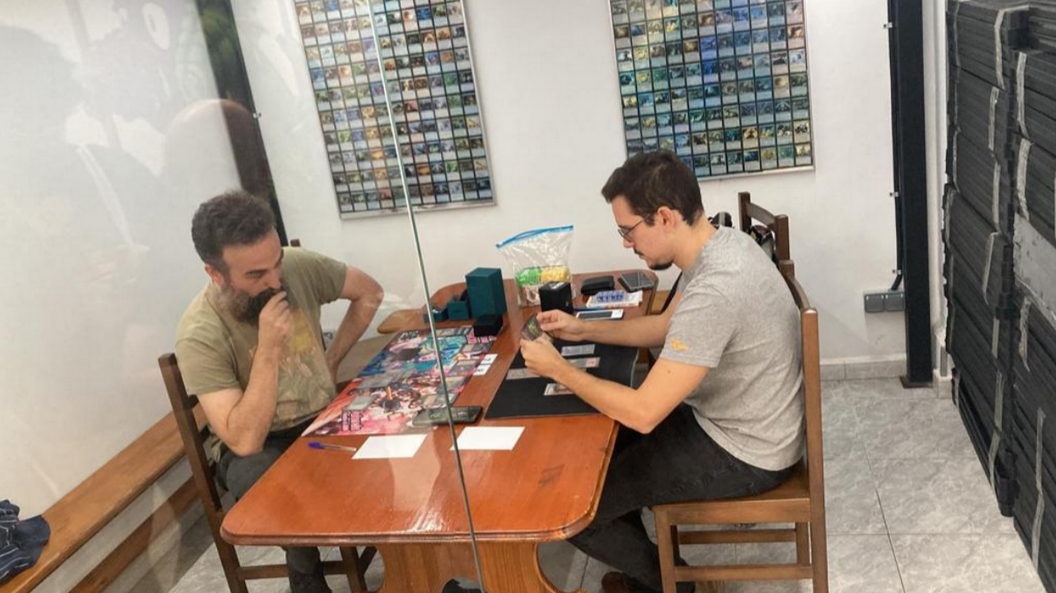 Pensándome seriamente la posibilidad de comprarme una bolsa Zip para transportar mis mazos
Quarter-finals: Black Curitas a.k.a Black Pope vs Ioanemm Markou
I had met Ioanemm the day before at the pre-Nationals, and we laughed a great deal during our game. Paradoxically it was the only game I did not win in that tournament.
This time the game was less relaxed. The lad is a 10, and very friendly, but he was clearly far more focused. His problem was that everything came up for me and I steamrolled him in record time. I won one of the games on turn 3, and that never happens with this deck. 2-0 with no chance for him. It was the pairing where I drew best; I finished in 10 minutes and then spent two hours waiting for an opponent to emerge from a match between another Goblins and a Landstill. It was the longest game I have ever witnessed, and to my misfortune Landstill took it.
Semi-finals: Black Curitas a.k.a Black Pope vs Antonio Padial
Drawing the way I had in the previous round was the only chance I had against Landstill; instead the pairing was embarrassing, a little kid’s deck against a real one. I started slowly in both games, the worst draws of the tournament, and I never had a chance. There is not much to say: I fought, as I usually do, but he had me completely dominated. In the end two Landstills beat me, and I left with the feeling that I had not prepared the pairing well enough.
I think people were a little disappointed, because right before that pairing was when they really started to believe that a Mono Black could win the Nationals. Nacho and plenty of other strangers gave me good advice on how to play against Landstill. Everyone was rooting for me, even people who did not know me; they interviewed me, and the buzz about an unknown deck taking the title was already in the air. But they wiped the floor with me exactly the way a mono black deck is supposed to be wiped.
In the end it was won by a lad from Madrid I do not know, playing a Sligh. Good for him — and he was also the one who knocked out Pablo Llanowar. I am not going to say I was pleased he beat the Landstill that knocked me out, but the truth is… I was pleased.
 El testigo del cinturon de campeón nacional
In any case, the best thing I took away from the tournament was the energy, the love and the good vibes everyone gave me. We stayed in the bar with a few beers watching the final on someone’s phone with Troin’s excellent commentary. It was a great weekend and it is much appreciated that people organise events like this. My congratulations to Sete and Nacho, and to the shop for putting up with a mob of berserker drunks. Already waiting for the next one — how long to go?